

Excursions Development Diary #2: The Tightrope
It’s no secret that Galactic Cruise is a hefty game, component-heavy and strategy-dense. For some people, this is the game’s greatest selling point. For others, this is the biggest detractor. When we signed Excursions, we knew we had a pretty precarious tightrope to walk as we began to develop the game. It had to have the spirit of Galactic Cruise, even some of the shared DNA, but had to be decidedly different: something lighter, but not light—something crunchy, but not overly so.
Some of these nuances came from Ben Rosset's original design. For instance, Ben removed the oxygen resource from Excursions, leaving only food and fuel to be tracked on the player boards. He also designed a lot of systems in the game to eliminate analysis paralysis, such as using a facedown deck of cards for the stops along the itineraries and a grab-bag for guests. These were major steps toward a smooth, simultaneous experience, as it didn’t require any of the trappings of some other games of this ilk (where the active player chooses an action, but then it still has to resolve around the table in turn order). Everyone can just grab cards; everyone can just stick their hand in the bag and pull out guests.
Again, these were great innovations that helped decrease the cognitive load and the playtime, but as lovers of (and publishers of) crunchy games, we wanted to ensure that the game didn’t lose too much of that crunch. Therefore, much of our development went into finding ways to dial up the agency in the game without there being too much additional overhead.
One thing that we tried was integrating a Reputation track into the game. The Reputation track in Galactic Cruise is a pivotal part of the game, and we thought that including that mechanism in Excursions would be a great way for players to have some differentiation in a game that was, in many ways, Bingo-esque.

The Galactic Cruise Reputation track, where players can spend Reputation to gain precious bonuses.
The Excursions Reputation track existed for a handful of plays. During those plays, there was an action that allowed you to gain Reputation (at the time, there were only a few upgrades on the player board, and building them was a free action)—and I believe it was a bonus on some other action(s)—and then you could freely spend it during your turn to gain items, much like you can do in Galactic Cruise. While this was an interesting concept, it did not work as smoothly in practice. Can you only use it when you’re the active player? Can you use it once every turn? What happens when six hands go for the track at the same time and we all bash knuckles?
And so the Reputation track had to go, and we instead pivoted to having the Cruise cards be multiuse, with each having a discard function printed at the top of the card. This had a similar effect to the Reputation track while also making the Cruise cards function a little bit like the Agenda cards from Galactic Cruise.
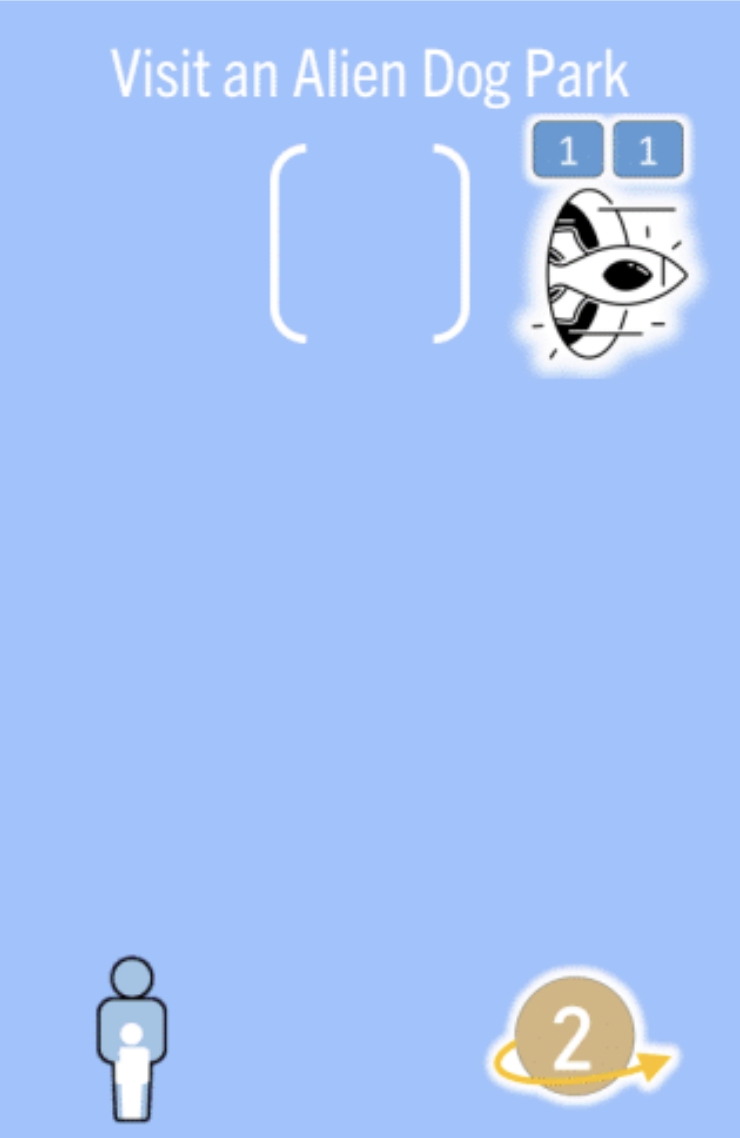
Ben's original Alien Dog Park
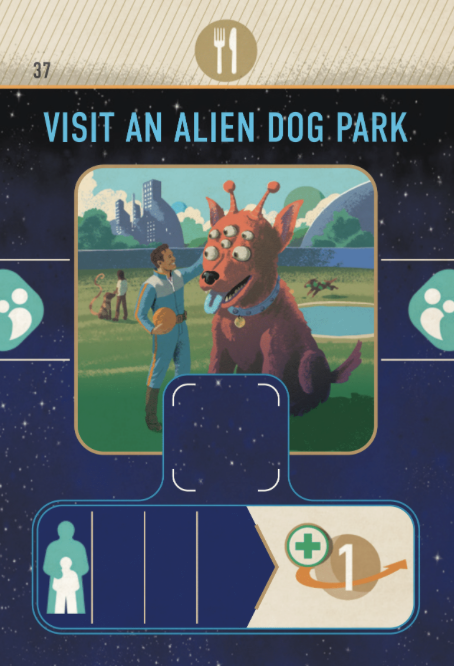
The current Alien Dog Park
Another thing we introduced into the game was some special rules for the active player. Since the turn structure of Excursions already features some special rules for the active player (i.e., they get to take a bonus when it’s their turn), we figured that would be a great place to insert a few more. This led to the lessening of randomization for two of the actions: Schedule (the action that allows players to gain cards) and Advertise (the action that allows players to gain guests). Usually, these are both blind draws—either cards from the top of the deck or guests pulled randomly from the bag, respectively. This new change now allowed the active player to choose their cards from a face-up display of five cards when choosing the Schedule action and to handpick the exact two guests they desire when taking the Advertise action. This was ultimately a win-win addition, as it did not add any discernible time to the playtime (players can clearly see, and plan to take, any cards that are visible, and they know exactly which guests they’re hoping to get when they shove their hand into the bag so choosing those same guests is a quick thing to do), and it helped to mitigate what could’ve been a feel-bad experience for deeply strategic players who don’t love the idea of their game hinging on nothing but blind draws.
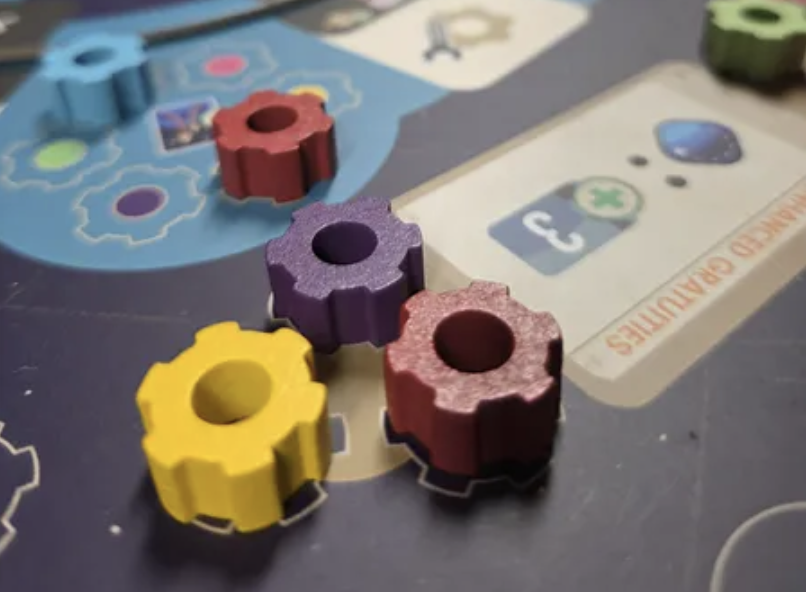
One of the aspects of Galactic Cruise for which we receive the most compliments is the way that Developments function, connecting locations together for combotastic turns! The overall spirit of this got ported over to Excursions, where Developments allow active players to connect main actions to adjacent bonuses and nonactive players to connect to adjacent actions, which allows the game to take a step away from the likes of Puerto Rico (where you can sometimes choose an action for the express reason that someone else can’t take that action) if players prepare accordingly.
To be clear, there is still a bit of an opportunity for the “I’m choosing to take resources because I know that Dennis can’t take resources—ha, ha, ha!” sort of playing if players haven’t prepared accordingly. Even then, though, Excursions does feature a consolation prize action printed in the middle of the central wheel. In the final version of the game, this consolation prize is a player’s choice of 1 Money, 1 Ad, 1 Resource, or 1 Card.
In the next development diary, I’m going to take a zoomed-in look at Ads in the game. Ben’s original design did not have Ads at all, but they are now a pivotal part of the game, so I thought it would be fun to take an in-depth look at them!