

Hey, everyone. I posted three development diaries for Excursions while I was away at SPIEL, but I did not crosspost them here. Instead of posting three separate diaries here, I've just consolidated them into a single post. Enjoy!
Development Diary #4: The Killing
“Kill your darlings.” It’s an old adage, and it’s most often used when referring to literary editing, but it’s really an excellent piece of advice for any creative endeavor. In order to bring the best version of a project to life, you must strip away the parts that don’t serve the greater purpose, even if those parts are (at least to you, the creator) incredible, near, and dear.
At any given time during a game’s development, we are constantly creating (and mercilessly laying waste to) these darlings. For a lot of games in our pipeline, this means we are constantly taking big swings, introducing or cutting away mechanisms, reconfiguring boards and cards and bits and bobs, and adding or subtracting one thing or another. For Excursions, we developed the game within a much tighter boundary, as we wanted to maintain the relative weight of the game and thought that Ben provided us an excellent framework to work within.
Looking back on the whole development journey, there were still plenty of little darlings that ultimately found their way to the chopping block, but I believe there was only really one major darling that we had to kill: upgradeable Developments.
For a rather long time, we had a mechanism in the game where, upon the accomplishment of a Company Goal during the game, you could choose one of your built Developments on the board and upgrade it. Physically, this would consist of slotting a cylindrical piece into the hole in the Development to mark it as upgraded (in the punchboard retail edition, this probably would have ended up being a double-sided piece that would be flipped when upgraded). An upgraded Development allowed an active player to take both the connected actions on their turn. At most, each player could have three upgraded Developments (one for each of the Company Goals), and at most could take two actions in a turn (though perhaps we also playtested a version where a player could take up to three actions if their chosen action was connected to actions by upgraded Developments on both sides—though that sounds extremely powerful!)
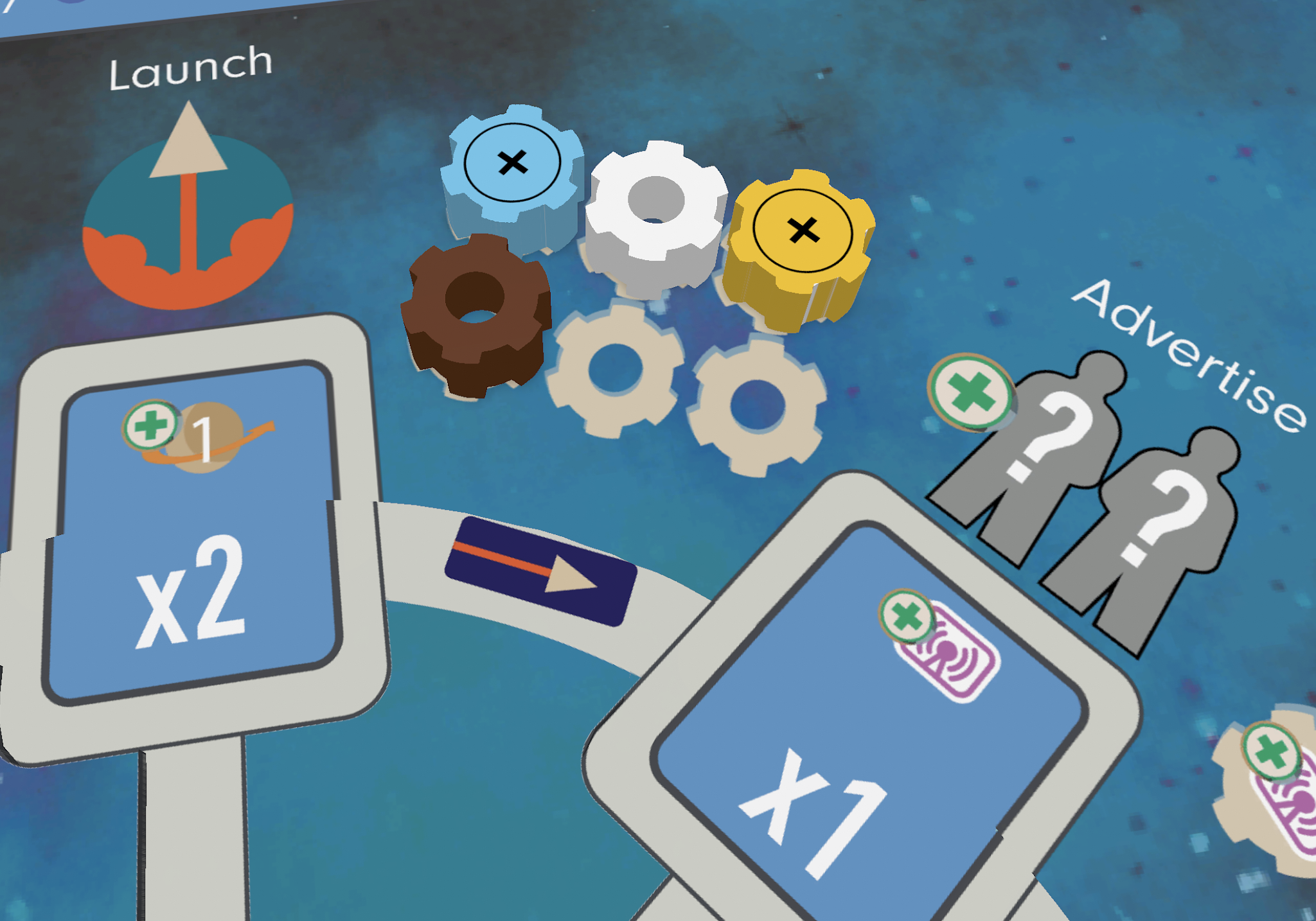
In this situation, the yellow and blue players would have the option, on their active turns, to combo together the Advertise and Launch actions—a pretty sweet combo!
This was a really fun addition to the game. It certainly made Development placement really interesting, and it definitely added even more urgency to the Company Goals, as accomplishing Goals as early as possible meant that players not only got the VP and funding bonuses, but they also got a great boost to their engine and another way to make themselves even more different from their fellow Cruise Directors. This upgradeable Development mechanism was especially popular among our playtesters who were avid Galactic Cruise fans, as it gave them another taste of the “big brother” game in the smaller package, as upgraded Developments function in a way that is quite similar to the Developments in Galactic Cruise. As avid players of Excursions ourselves, we loved the crunchiness of the decision space!
Of course, the flip side of that coin is that it did add some added complexity to a game that was touted as a lighter, smaller, more streamlined game. While, like I mentioned, plenty of our playtesters loved the mechanism, many others felt that it added just a bit too much to the game. It was, to use the old cliche, a bridge too far. Ultimately, we made the call to cut the upgraded Developments from the game.
For a while, we toyed with the idea of including the upgraded Developments as a sort of module or mini-expansion for Excursions and including it in the Kickstarter, but ultimately decided against it. Of course, if Excursions does well and warrants an expansion down the road, I would not be at all surprised if these Development upgrades made their way into such a product! But it’s probably a little early to talk about more content for a game that isn’t even out yet….
***
Development Diary #5: Upgrades!
There are few words that get a eurogamer’s heart racing much more than the word “upgrade.” The opportunity to improve your position in a game, to intensify the power of an action, to increase your capabilities—it’s all very exciting.
In the original design that Ben pitched us, there were a few upgrades already in the game. You could increase your ship’s capacity, and there were a couple of pilot upgrades available. To unlock these upgrades, you could spend money as a free action to gain that access. As we did more and more internal playtesting, our minds started mulling over the same question: what else could we be upgrading? What about this? What about that?
When we ultimately made the decision to do away with the Reputation track, we needed a seventh action to replace the one that used to give Reputation. As a fascinating side note: the reason that the game has to have seven actions is that seven is a prime number whose value is higher than the maximum number of players. This ensures that the bonus-multipliers will never be the same on a player’s consecutive turns, which eliminates there being unfair (or even insurmountable) advantages based on a seemingly random configuration of the central wheel during setup.
Anyway, enough math talk. Back to the topic at hand: we needed a seventh action.
We really loved the upgrading aspects from Galactic Cruise, where each time you launch a cruise, you take a launch tower token along with you and drop it off at one of the destinations you visit. This oftentimes results in a really lucrative one-off bonus, but more often results in you gaining a powerful ability for the rest of the game (and possibly a permanent upgrade to one of your funding options). In an average game of Galactic Cruise, a player may end up with three or four of these upgrades (possibly more, depending on other aspects of the game and whether or not players are also using the Galactic Cruise: Accommodations expansion). These opportunities for upgrading are great in GC, but for Excursions, we really wanted to really dial up the upgradeability (which I’m not 100% sure is even a word)!
The minutia of exactly what the upgrades do for players has changed as we’ve continued the development, but how it essentially works is this: building an upgrade is now one of the actions that players can choose. When it is chosen, players can build one of the nine upgrades found on their player board. By separating the ability to upgrade from any sort of launch/advance mechanism, we are allowing players to more easily (and, often, more quickly) build their engine.
This upgrade mechanism was another really strong step toward agency in a game that, due to its simultaneous nature, had to have a bit of that GC-level strategy trimmed down. While, yes, it is true that any turns where you are not the active player will feature actions that you did not choose (which may involve a blind-draw from the guest bag, or a blind-draw from the top of the card deck), any time the upgrade action is chosen, you get to build whichever upgrade you want to build—which might be your personal lounge, where you can place guests without having to commit them to a cruise immediately…or the upgrade that increases your hand limit…or the one that makes your ships larger…or the one that makes your default 4:1 trade into a 3:1…or the one that—you get the idea!
For me, upgrades are the finest thing that we introduced into the game. They are so fun and useful, and when there are technologies in the game that really synergize with the upgrades / my private goals / my whims of the day, my love of them intensifies!
For those of you who have played the game, either at a convention or on TTS, which upgrade is your favorite?
***
Development Diary #6: Don't Be a Square!
Ask a random person to do a drawing of a board game, and what will you get? Maybe some dice, some cards, a rendering of a square board (that more often than not resembles Monopoly). Ask a modern gamer to do a drawing of a board game, and the result will be much more varied. Perhaps there are no dice at all, or perhaps there are lots of dice of various polyhedral shapes. There may be some cards or some tiles. There may be meeples or standees or miniatures. There may not even be a board at all in the board game! But if there is a board, it’s most likely still square (or, at least, quadrilateral, with many games now opting for a rectangular shape). This latter feature has stayed pretty standard in games with boards, even as everything else has become more and more varied.
As gameplay development for Excursions was progressing toward completion, we had the first of several meetings with Ian O’Toole to discuss the art direction of the game. We discussed the card layouts and chatted quite a bit about iconography—what would get ported over from Galactic Cruise, and what new icons needed to be created to convey new information? Things like that. At some point in that conversation, the shape of the board was brought up. Looking back, I’m not sure if it was us that brought it up to Ian or if it was Ian who brought it up, but at some point in the conversation, someone brought up the idea of having a circular central board, which then prompted the other party to say, “I/We thought of that, too.”
And so the circular central board was born!
Admittedly, this is not exactly a piece of gameplay-related development and more of a publishing decision, but I see game development as anything that improves the user experience and makes the game better—and shifting the design to a circular board accomplishes those things! By having the game board configured the way it is, there is no “right side up” and “upside down” for players, and the lack of corners means that players can (when physically possible) be closer to the game and can see its elements more clearly.
It’s also allowed us to really lean into the circular nature of the game. After all, it’s a game that revolves around (pun intended) a rotating space station! The proposed player trays in the Deluxe Edition are circular, and the resource tray is curved to sit alongside the round board. Heck, if we weren’t afraid of it rolling off the retail shelves, we probably would have made the box a circle as well! (Kidding, of course.)
In my final development diary (which I’m posting on October 29th), I’ll dive into all the remaining work that needs to be done for Excursions in order to take it from a Kickstarter campaign to a beloved game on your table!